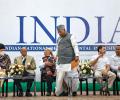
Rahul Gandhi's focus will be on his Nyay Yatra, rather than the INDIA bloc's election campaign, leading to speculation among allies that the Congress leader is already looking at the Opposition's fight beyond May 2024.

The outfit suggested that the government amend the Information Technology Act to classify all such content as pornography, which people should only be able to access by punching in their Aadhaar details or their fingerprints. Archis Mohan reports

More than ever before, women voters can make or mar a political party's electoral fortunes.
'Most of the bot attacks have originated from outside India.' 'Our firewalls are resilient and withstood the attacks.'

Jeetega Bharat has selected 125 Lok Sabha seats across the country where it will assist the Opposition alliance.
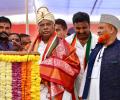
The Congress president during his year at the helm of the party has repaired the citadel for far more challenging years ahead, and played a crucial role in shaping the Opposition alliance.
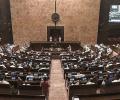
The BJP holds 28 of the 59 Rajya Sabha seats that will soon face election.

The BJP and Congress are the top two beneficiaries of the electoral bonds, followed by the Trinamool Congress.

Seizures in poll-bound states see sharp rise since implementation of Model Code of Conduct.

Naveen Patnaik is known as an "absentee landlord" who needs bureaucrats like Pandian to run his government.
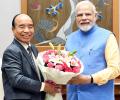
At 79, Zoramthanga is working to rebuild his image as the people's CM.
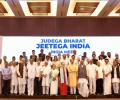
Some constituents of the alliance have raised concern that the panels, particularly the 14-member coordination committee, are at risk of becoming ineffective, as their decisions have so far not been acted upon.

Women politicians bring to politics and policy a sensitivity that most of their male counterparts, at least until a generation back, lacked.
The BJP senior leadership believes the YSRCP is a more reliable potential ally post-2024 Lok Sabha election than the TDP.

While Modi has spent fewer days abroad than his predecessor (270 days versus Dr Singh's 306), he has travelled more extensively and actively than any other Indian PM.
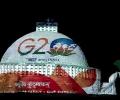
'The group commands 85 per cent of the global GDP, and if you are able to convey your point of view effectively to this group then you have reached more or less all the important players that matter.'

'There was a 77 per cent chance that electorates in India voted for the same party for both the state and Centre when elections were held simultaneously.'

An exhibition on the origins of Indian art, culture, handicrafts, and India's grassroots farming innovations is scheduled for September 9 and 10.

Should he begin the yatra from Gujarat's Porbandar, the birthplace of the Mahatma, on October 2, and skip campaigning for the five assembly polls?
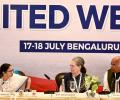
'Most leaders, from Lalu Yadav and Mamata to M K Stalin, respect and trust Sonia. She should continue unless she expressly declines.'
